From CAFOs to Catastrophe: The Shocking Toll on Aquatic Life
In the heartland of industrial agriculture, vast Concentrated Animal Feeding Operations (CAFOs) churn out copious amounts of animal “products”. Cows, Pigs, Chickens, and Turkeys in CAFOs are housed typically in large buildings or feedlots. They are not allowed to roam freely or have anything resembling a normal life. Instead, they are crammed in a space with thousands or tens of thousands of animals to make feeding and waste collection “efficient” and reduce the land area needed. Having limited or no access to pasture or outdoor areas, the “livestock” are fed a controlled diet, often consisting of feed optimized to cause rapid growth. In this way, CAFOs increase their production and profits.
Like any other living being, the animals in CAFOs excrete. One can imagine — even if one doesn’t want to — the amount of waste, including manure and urine, generated in a day by a CAFO having so many animals. In fact, large CAFOs can produce more waste than some U.S. cities—a feeding operation with 800,000 Pigs can produce over 1.6 million tons of waste a year! “Farmed” animals in the U.S. are estimated to produce as much as 1.2–1.37 billion tons of waste every year!
All of this waste must be disposed of. However, there are little to no regulations in place to dispose of this waste. From CAFOs that practice open-air manure storage or use uncovered feedlots, excess manure is carried by rainwater into streams, rivers, and lakes.
Imagine the tranquil, winding rivers and serene lakes that grace our landscapes – nature’s intricate web of aquatic life. In these waters, a complex tapestry of ecosystems thrives, from the tiniest aquatic Insects to the mightiest of Fish. Or it would— if it weren’t for the silent but significant invasion of manure.
Manure contains high concentrations of nutrients such as nitrogen and phosphorus. When these nutrients get washed into nearby water bodies, they promote the growth of algae and aquatic plants, a process known as eutrophication. Some types of algae thrive under such nutrient-rich conditions, producing harmful algal blooms (HABs). HABs use up oxygen and when they die off, their decomposition consumes even more oxygen. This degrades water quality and depletes oxygen levels in the water.
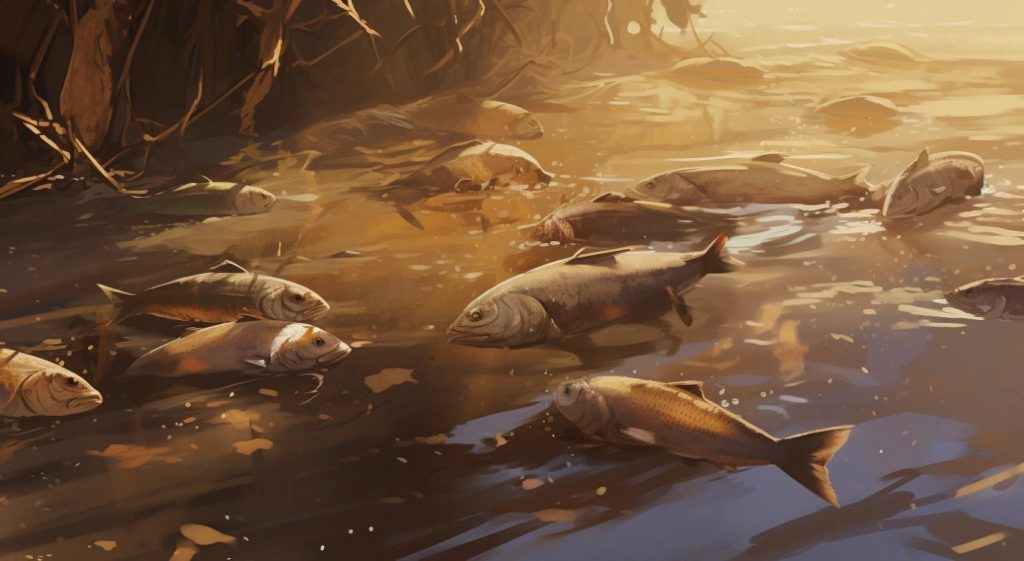
Many fishes like Salmon, Trout, Catfish, and Bass are sensitive towards water quality and oxygen levels, requiring well-oxygenated water for their survival, growth, and reproduction. Reduced oxygen suffocates Fish and leads to their deaths. For example, 66,000 Fish were reported to have died in just four days in a tributary of Lake Erie which had become contaminated with manure!
Fish are also sensitive to ammonia concentrations, which is also present in animal waste, and high ammonia content from manure is lethal to them. For example, in Wabasha County, Minnesota, ammonia in a Cow manure discharge killed 16,500 Minnows and White Suckers.
An EPA report compiled the reports of events of Fish kills like these caused by manure released by such operations. The shocking numbers of deaths, which are in the order of hundreds of thousands, shed light on the sheer magnitude of the problem. For example, a pig CAFO killed 1 billion Fish in Neuse river in NC! Nearly 35,000 Fish died in Tipton Creek, IA, because of a pig CAFO, for which it was fined a mere $200. Manure from a “poultry” CAFO in Pokomoke River, MD killed 20,000-30,000 Fish and affected 13 humans. Deaths of over 6,000 Catfish, Smallmouth Bass, Rock Bass, White Bass, and Minnows in Blue Earth River, MN and 6,000 Brown Trout and White Suckers in Hay Creek, MN caused by animal manure were recorded. The list goes on and on. Nearly 100 distinct Fish death events in over a 10-year period associated with spills and discharges from such operations have been reported. Following these events, the EPA attempted to strengthen the CAFO manure management regulations but the regulations have been criticized as being inadequate because of several shortcomings.
Manure carried by rainwater into streams, rivers, and lakes, also leads to sedimentation. The deposition of fine particles disrupts aquatic habitats, can smother fish eggs, clog fish gills, and impact reproduction of aquatic animals and organisms. Turbidity from the blooms can limit growth of aquatic vegetation, which are a critical habitat for Fish, Crabs, and other aquatic organisms, by reducing penetration of sunlight.
Water pollution caused by CAFOs generate several more problems for humans as well. Improper waste management practices lead to the leaching groundwater contamination, which can contaminate drinking water sources and make them unsafe for human consumption. Animal waste containing harmful pathogens and bacteria that contaminates nearby water sources poses risks to human health when people come into contact with or consume it. Contact with, and drinking such water, has led to severe sickness in humans and death for other animals. For example, certain bacteria in livestock waste cause diseases that have killed thousands of migratory waterfowl. Shellfish like Oysters and Clams are also susceptible to contaminants from CAFO-related runoff, such as bacteria or chemical pollutants, which can accumulate in their tissues and pose health risks to those who consume Oysters and other similar animals.
And so, we see that CAFOs harm and kill way more animals than the ones they sell. Fishes are helpless in polluted water with no options for escape. Imagine breathing toxic air and being unable to escape it, until it sickens and slowly suffocates and kills everyone who relies on clean air. But while Fish are being suffocated alive in their own homes, the EPA is still only planning to study the problem before deciding whether further regulations are needed.
Sadly, water pollution is just one mechanism of the environmental problems caused by the production of large quantities of waste in CAFOs; the others include air pollution and greenhouse gas emissions. It is high time, therefore, that we push for more regulations on CAFOs to prevent further destruction of life, our natural environment, and our communities.
Further reading:
- https://www.nrdc.org/bio/valerie-baron/big-ag-hiding-plain-sight-and-its-making-us-sick
- https://www.nrdc.org/sites/default/files/cafos-dont-know-hurting-us-report.pdf